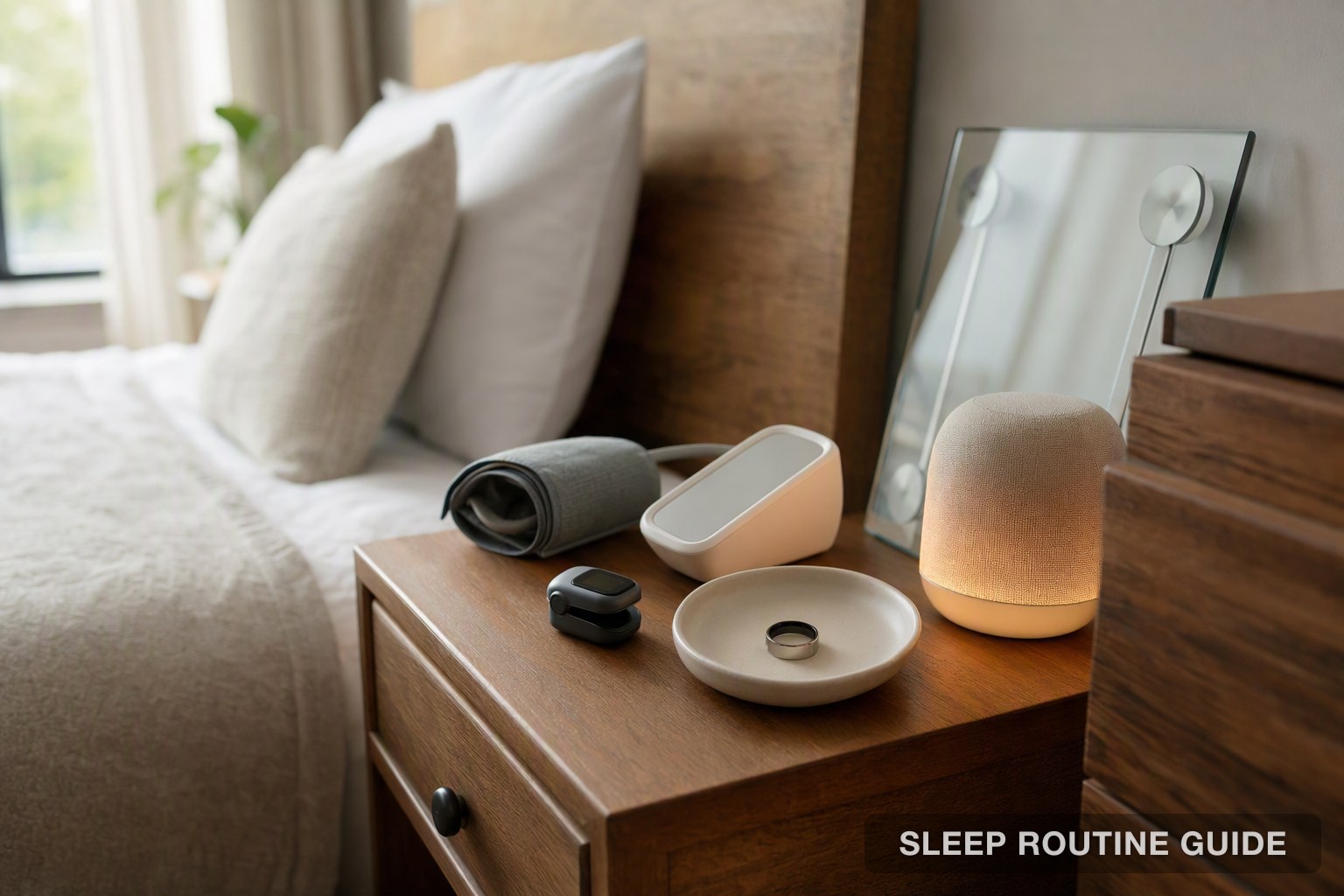
6 Smart Home Health Device Investment Opportunities for 2026, Ranked by Investor Access
Six smart home health device segments are open to investors in 2026, but only two have listed specialists: sleep apnea testing and therapy (ResMed, NYSE: RMD, $5.7 billion fiscal 2026 revenue; Inspire Medical, NYSE: INSP, $912.0 million in 2025) and wearable health hubs (Apple, Alphabet, Garmin). Oura filed an S-1 showing $907.9 million of fiscal 2025 revenue, then postponed its Nasdaq IPO on September 29, 2026, while Whoop ($10.1 billion valuation) and Eight Sleep ($1.5 billion) remain private. Blood pressure monitors, smart scales, bedroom environment devices and bedside sleep devices such as Hatch and Naptick ($349, preorder, wellness-positioned) are mostly private, and Sleep Number and Airthings both left their exchanges in 2026. FDA records show review times of 107 to 457 days for the cleared products named, not the 3 to 7 years often quoted.
The smart home health device investment opportunities a retail investor can actually act on in 2026 are concentrated in two of six segments. Home sleep testing and apnea therapy has two listed specialists: ResMed (NYSE: RMD), which reported fiscal 2026 revenue of $5.7 billion, and Inspire Medical Systems (NYSE: INSP), with $912.0 million in 2025 revenue. Wearables that double as home health hubs come second, through Apple (Nasdaq: AAPL), Alphabet (Nasdaq: GOOGL) and Garmin (NYSE: GRMN), with Oura's Nasdaq listing filed and then postponed on September 29, 2026. The other four segments are connected blood pressure and cardiac monitors (Omron in Tokyo, AliveCor and Withings private), smart scales, bedroom environment devices (Eight Sleep, private at a $1.5 billion valuation) and bedside sleep devices (Hatch and Naptick, both private). Those four are mostly private-company territory, which in the United States means accredited-investor rounds or, where a company chooses to run one, a Regulation Crowdfunding offering.
We ranked the six by investor access, meaning whether there is a listed security, audited numbers and an FDA-cleared product behind the story. It is not a ranking of expected returns, which nobody can give you honestly.
Key takeaways
- Two segments have listed specialists with audited financials: sleep apnea testing and therapy (ResMed, Inspire Medical) and wearable health hubs (Apple, Alphabet, Garmin). In the other four you are mostly looking at private companies.
- Oura is the closest thing to a new listing. Its S-1 shows $907.9 million of fiscal 2025 revenue and 5.0 million paid members, but the company postponed the IPO on September 29, 2026 and gave no new date.
- FDA status is a product-level fact, not a company-level one. Apple's sleep apnea and hypertension notifications are 510(k) cleared, while Oura tells investors it markets its ring as a general wellness product.
- Two companies an investor might have reached for a year ago are no longer on an exchange. Sleep Number filed for Chapter 11 in June 2026 and was delisted from Nasdaq. Airthings left Euronext Oslo Børs in February 2026.
- Bedside sleep devices are the earliest-stage segment. Naptick, a $349 wellness device on preorder, and Hatch, whose Restore 3 sells for $169.99, are private, and we found no public offering from either.
- The "3 to 7 year" FDA timeline often quoted for this category did not survive checking. FDA's own database shows review times of roughly 3.5 to 15 months for the cleared products named here.
The six segments at a glance
| Rank | Segment | Names to know | Listed route for a retail investor | Regulatory posture |
|---|---|---|---|---|
| 1 | Home sleep testing and apnea therapy | ResMed, Inspire Medical, Withings Sleep Rx, Beacon Biosignals | Yes: RMD and INSP on the NYSE | Mostly FDA-cleared or approved medical devices |
| 2 | Wearables and rings as home health hubs | Apple, Alphabet (Fitbit), Garmin, Samsung, Oura, Whoop | Yes for Apple, Alphabet, Garmin. Oura filed, then postponed. Whoop private | Mixed: cleared features sitting on wellness hardware |
| 3 | Connected blood pressure and cardiac monitors | Omron, AliveCor, Withings | Partly: Omron's parent is listed in Tokyo. AliveCor and Withings are private | Medical devices; cuffs and ECGs are outside the wellness policy |
| 4 | Smart scales and body composition | Withings, Garmin Index S2, Fitbit Aria | No pure play. Exposure only inside Garmin or Alphabet | Body fat estimation has been FDA-reviewed since at least 2014 |
| 5 | Bedroom environment and air quality | Eight Sleep, Airthings, Sleep Number | No. Eight Sleep private, Airthings delisted, Sleep Number bankrupt | Wellness today; Eight Sleep is seeking FDA authorization |
| 6 | Bedside sleep devices | Hatch, Naptick | No | General wellness |
How we evaluated
Three questions decided the order. Can someone with an ordinary brokerage account buy the security? Has the company published audited financials, or is the only number a valuation from a funding announcement? And does it sell at least one product that the FDA has cleared, approved or granted, as opposed to one marketed under the general wellness policy?
Listings and tickers come from SEC EDGAR records and company filings. For clearances we queried the FDA's 510(k) and De Novo databases by applicant name and recorded the submission number and dates. Funding figures for private companies come from press coverage, because private companies do not file them anywhere we can check. Naptick and Hatch product details were read from their own websites on October 13, 2026.
We did not test any device or model valuations. We also threw out every market-size forecast in the source material for this piece, because none could be traced to anything better than a research vendor's press summary. The revenue figures below are ones companies reported under securities law.
1. Home sleep testing and apnea therapy
Sleep apnea is the one corner of smart home health where the home device is plainly a medical product and the investable companies are plainly public. A 2019 analysis in The Lancet Respiratory Medicine estimated that 936 million adults aged 30 to 69 have mild to severe obstructive sleep apnea worldwide, and 425 million have the moderate to severe form. Read that figure knowing ResMed funded the study.
ResMed (NYSE: RMD, ASX: RMD) is the pure play. Fiscal 2026 revenue rose 10% to $5.7 billion, and the fourth quarter alone reached about $1.5 billion. NightOwl, a fingertip sensor that pairs with a phone, was first cleared for Ectosense NV under 510(k) K191031 in March 2020, and ResMed made it available across the United States in April 2025. A month later it bought VirtuOx, an independent diagnostic testing facility that runs at-home sleep, respiratory and cardiac tests.
Inspire Medical Systems (NYSE: INSP) belongs in the conversation but not quite in the category. Its 10-K reports 2025 revenue up 13.6% to $912.0 million, and the FDA approved the Inspire V neurostimulator in August 2024. But Inspire is an implant placed in an outpatient surgical procedure, not a device you buy and plug in. The same filing warns that a billing-code change for the Inspire V procedure may affect future revenue.
Private names sit around the two listed ones. Withings' under-mattress Sleep Rx mat was cleared as K231667 in September 2024. Beacon Biosignals holds clearances for its Dreem 3S EEG headband (K223539, August 2023) and for SleepStageML, sleep-staging software cleared in March 2024.
What to consider
- ResMed is a large, mature company. You are buying a CPAP and software business with a testing funnel attached, not a startup growth curve.
- Inspire's revenue depends on surgeon capacity and payer coding, both of which its own filing flags as constraints.
2. Wearables and rings as home health hubs
Wearables earn a place in a home health article only where they do a job a clinic visit used to do. More of them now do. Apple's Sleep Apnea Notification Feature was cleared under K240929 on September 13, 2024, and its Hypertension Notification Feature under K250507 on September 11, 2025. Samsung's Sleep Apnea Feature came through the De Novo route (DEN230041, February 2024). Fitbit, now part of Alphabet, has clearances for its ECG app (K200948), irregular rhythm notifications (K212372) and loss of pulse detection (K242967, February 2025). Garmin's ECG app is K221774.
The catch for investors is dilution. Apple (Nasdaq: AAPL), Alphabet (Nasdaq: GOOGL and GOOG) and Garmin (NYSE: GRMN) are all easy to buy, and in none of them is home health the reason the share price moves.
Oura would have been the first pure-play listing. Its S-1, filed September 3, 2026 puts audited numbers where the rest of the sector has press releases. Revenue grew from $406.8 million in fiscal 2024 to $907.9 million in fiscal 2025 (Oura's year ends in September). For the nine months to June 30, 2026 it reported hardware revenue of $974.0 million, membership revenue of $240.5 million and net income of $60.8 million. It had 5.0 million paid members and a weighted-average 12-month paid member retention of about 85%. Oura applied to list on the Nasdaq Global Select Market under the symbol OURA, launched the offering at $40 to $44 a share, and then postponed it on September 29, citing "uncertainty in the IPO market". As of October 13, 2026, EDGAR shows no pricing prospectus. There is no Oura stock to buy.
Two details in that filing deserve a second read. About 80% of revenue in the latest nine months was hardware, so this is still a device business with a subscription on top. And Oura states that it markets the ring and app "as general wellness products" that it believes are not actively subject to FDA medical device requirements, then spends a page explaining what happens if the FDA disagrees.
Whoop is private. It announced a $575 million Series G at a $10.1 billion valuation at the end of March 2026, led by Collaborative Fund. We come back to its regulatory history in the FDA section below.
If your interest is specifically sleep (smart mattresses, sleep rings, coaching startups), our guide to the best companies to invest in for smart sleep covers that narrower field, and we have not repeated its company profiles here. One update to it: Sleep Number is no longer a listed company (see segment 5).
3. Connected blood pressure and cardiac monitors
Home blood pressure monitoring has something most consumer health tech lacks, which is a clinical guideline telling doctors to use it. The U.S. Preventive Services Task Force recommends obtaining blood pressure measurements outside the clinical setting to confirm a hypertension diagnosis before starting treatment. The CDC reports that nearly half of U.S. adults have high blood pressure, and many do not have it under control.
Omron dominates the cuff. Omron Healthcare said in September 2025 that cumulative sales of its blood pressure monitors had passed 400 million units, with distribution in more than 130 countries and regions. Omron Healthcare is a subsidiary of Omron Corporation, a Japanese industrial automation group whose shares trade in Tokyo. A U.S. retail investor would be buying a foreign-listed conglomerate in which blood pressure monitors are one division. We could not load Omron's investor pages during this review, so confirm the listing details with your broker.
AliveCor is private. It makes the KardiaMobile personal ECG line, including the six-lead KardiaMobile 6L cleared under K210753 in June 2021, and the FDA database lists AliveCor clearances as recent as January 2026. Withings, also private, has clearances for its Scan Monitor watch ECG (K201456 and K230812) and for the BeamO multi-sensor device (K252474, November 2025).
There is no wellness shortcut in this segment. The FDA's general wellness guidance names blood pressure monitors, blood glucose meters and ECG recording devices as examples of products that are not general wellness products. A company selling a cuff has to do the regulatory work.
What to consider
- No U.S.-listed pure play exists.
- Cuffless estimation on watches and rings is the open question. Whether that becomes a medical-grade market or stays a wellness feature depends on FDA policy that changed as recently as January 2026.
4. Smart scales and body composition
Smart scales are in almost every "smart home health" market definition and almost no investor's portfolio, for a simple reason. Nobody listed makes most of their money from them.
The products are real enough. Withings built its name on connected scales. Garmin sells the Index S2. Fitbit's Aria WiFi Smart Scale went through the FDA as far back as 2014 (K133872), a reminder that estimating body fat is a regulated function.
As an investment segment it is thin. Exposure comes only as a rounding error inside Garmin or Alphabet, or through Withings. We found no listed Withings shares and no funding round more recent than a $60 million raise reported in 2021, but we could not load the company's own site to confirm its ownership. Treat the "private" label as our best reading.
Scales are better understood as an entry point. A scale gets a household onto a company's app, and the watch, the cuff or the subscription follows. That matters when you evaluate Withings or Garmin. It is not a reason to look for a scale stock.
5. Bedroom environment and air quality
This is where 2026 has been hardest on investors.
Eight Sleep has the headline. It raised $50 million at a $1.5 billion valuation in March 2026 in a round led by Tether Investments, after a $100 million round in August 2025. TechCrunch, citing Crunchbase, puts total funding above $310 million. The company told TechCrunch it has sought FDA approval for products that detect and mitigate sleep apnea. We searched the FDA's 510(k) database for "Eight Sleep" as an applicant and found no clearance, so as far as public records show, that authorization has not arrived. Eight Sleep is private and does not publish revenue.
Sleep Number was the listed smart bed company. It filed for Chapter 11 on June 12, 2026, and its 8-K records that Nasdaq suspended trading on June 23. A court later approved the sale of substantially all its assets to a subsidiary of Sleep Country Canada.
Airthings, the Norwegian maker of radon and indoor air quality monitors, was the closest thing to a listed air quality pure play. Its shares were delisted from Euronext Oslo Børs as of February 12, 2026.
That leaves one well-funded private company and two former listings. None of these products is cleared to treat anything, and a bedroom air sensor tells you about the room, not about your health.
What to consider
- Eight Sleep's valuation is a private-round figure, set by a small number of investors, with no disclosed revenue to check it against.
- A regulatory filing is a cost before it is an asset. If Eight Sleep's apnea features are authorized, the product changes category. If not, the money is spent.
6. Bedside sleep devices
Bedside devices are the youngest segment here: nightstand hardware that combines light, sound and sensing, sold direct to consumers as wellness products. Our explainer on what a sleep coach is covers the consumer side of what they do.
Hatch is the established name. The Restore 3 sells for $169.99 with 30 days of the Hatch+ subscription included, so its model is low-priced hardware plus recurring content revenue. We found no listed shares and no public offering.
Naptick is an early-stage entrant, and it should be described as that. Its product page lists a $349 device on preorder with an AI voice companion called Nap, a library of more than 1,000 soundscapes, a dimmable light for wind-down and wake-up, and eight room sensors covering CO2, VOCs, particulates, temperature, humidity, light and noise, rolled into a 0 to 100 room score. The app is included and Naptick says there is no subscription. The company's science page states that Naptick "is a wellness device designed to support healthy sleep habits. It is not a medical device and is not intended to diagnose or treat any condition."
That positioning is the opposite of Hatch's on revenue (one-time hardware, no subscription) and the same on regulation (general wellness, no FDA submission). For an investor, the more important facts are the ones that are missing. Naptick's site discloses no funding, no investors, no revenue and no unit sales. We found no securities offering of any kind.
What to consider about Naptick
- It is a preorder product. On October 13, 2026 the site still said batch 3 "ships August 2026", a date already past, so we could not confirm from the site that units are in customers' hands at volume.
- The app is iOS only. Android is listed as "coming soon".
- With no subscription, revenue depends on selling more devices. That removes churn risk and also removes recurring revenue.
- It makes no clinical claims and has no published trials. The testimonials on its site are customer quotes, not evidence.
- At $349 it costs roughly twice a Hatch Restore 3, in a segment where Apple, Google and Amazon could add similar sensing to devices people already own.
Hatch has its own version of these risks. Its recurring revenue depends on customers keeping a subscription after the free month, and like Naptick it has no cleared medical function, so no regulatory moat.
What a retail investor can actually buy
| Company | Status on October 13, 2026 | Ticker and exchange |
|---|---|---|
| ResMed | Public | RMD, NYSE (also ASX) |
| Inspire Medical Systems | Public | INSP, NYSE |
| Apple | Public | AAPL, Nasdaq |
| Alphabet (Fitbit, Google) | Public | GOOGL and GOOG, Nasdaq |
| Garmin | Public | GRMN, NYSE |
| Omron Corporation | Public in Japan | Tokyo listing (not verified by us) |
| Oura | S-1 on file, IPO postponed | OURA applied for on Nasdaq; nothing to buy yet |
| Whoop, Eight Sleep | Private | None |
| Withings, AliveCor, Hatch, Beacon Biosignals | Private | None |
| Naptick | Private, early stage | None; no offering found |
| Sleep Number | Chapter 11 | Removed from Nasdaq |
| Airthings | Delisted | Removed from Euronext Oslo Børs |
For the private rows, U.S. securities law sets the routes. Most venture rounds are sold only to accredited investors. The SEC's definition for individuals is net worth over $1 million excluding a primary residence, or income over $200,000 (or $300,000 with a spouse or partner) in each of the prior two years, with a reasonable expectation of the same this year. Holders of a Series 7, Series 65 or Series 82 licence in good standing also qualify.
The other route is Regulation Crowdfunding, which lets a company raise up to $5 million in a 12-month period from the general public through an SEC-registered intermediary, either a broker-dealer or a funding portal. Anyone can invest, but the SEC limits how much a non-accredited investor can put in over 12 months based on income and net worth. A company has to choose to run such an offering, and we did not find a live one from any company named here. Treat an unsolicited offer of "pre-IPO shares" in Oura, Whoop or Eight Sleep as a warning sign.
FDA status: wellness product or cleared device?
The single most useful diligence question in this category is which regulatory box each product sits in. A claim that circulates in pitch material is that FDA clearance takes "3 to 7 years". That is not what the FDA's records show.
| Product (company) | Submission | Received | Decision | Days under review |
|---|---|---|---|---|
| Sleep Apnea Notification Feature (Apple) | 510(k) K240929 | Apr 4, 2024 | Sep 13, 2024 | 162 |
| Hypertension Notification Feature (Apple) | 510(k) K250507 | Feb 21, 2025 | Sep 11, 2025 | 202 |
| Sleep Apnea Feature (Samsung) | De Novo DEN230041 | May 31, 2023 | Feb 6, 2024 | 251 |
| NightOwl (Ectosense, now ResMed) | 510(k) K191031 | Apr 18, 2019 | Mar 6, 2020 | 323 |
| Sleep Rx (Withings) | 510(k) K231667 | Jun 7, 2023 | Sep 6, 2024 | 457 |
| SleepStageML (Beacon Biosignals) | 510(k) K233438 | Oct 13, 2023 | Mar 8, 2024 | 147 |
| ECG Feature (Whoop) | 510(k) K243236 | Oct 10, 2024 | Apr 4, 2025 | 176 |
| KardiaMobile 6L (AliveCor) | 510(k) K210753 | Mar 15, 2021 | Jun 30, 2021 | 107 |
Those are review times only. They leave out the clinical studies and engineering that come before a submission, which can take years and which nobody publishes. Still, 3.5 to 15 months is a long way from "3 to 7 years".
On the other side sits the FDA's General Wellness: Policy for Low Risk Devices guidance, reissued in January 2026. Under it, the agency does not intend to examine low-risk products that make only general wellness claims. The 2026 text adds that non-invasive products estimating parameters such as blood pressure, oxygen saturation or heart rate variability may qualify when the outputs are intended solely for wellness uses and other conditions are met. It also lists what does not qualify, including products whose labeling, advertising or interface refers to specific diseases, clinical conditions or diagnostic thresholds.
Whoop shows how that plays out. The FDA sent Whoop a warning letter on July 14, 2025 over its Blood Pressure Insights feature. Eleven months later, on June 17, 2026, the agency issued a closeout letter saying that, based on changes Whoop made to the product and its labeling and consistent with the updated guidance, it does not intend to enforce device requirements for the feature "as modified". The letter is explicit that it covers that product only.
Wellness positioning is cheaper and faster, and it rests on guidance the FDA itself labels nonbinding. The line moved twice within a year for Whoop, which is the risk Oura's prospectus describes at length.
Limitations
- We did not verify Omron Corporation's listing details, Withings' ownership or Hatch's corporate status from primary documents. Their sites blocked automated requests or publish no investor information. Those companies are described from press coverage and product pages.
- Private-company valuations (Eight Sleep at $1.5 billion, Whoop at $10.1 billion) are figures from funding announcements reported by the press. They are not audited and say little about what a later investor would pay.
- Our FDA searches were by applicant name. A company can hold a clearance under a subsidiary or a contract manufacturer's name, so "we found none" for Eight Sleep means none under that name.
- Market forecasts, retention "benchmarks", gross margin ranges and acquisition multiples that appear in other coverage of this topic had no traceable source and are not used here.
- Oura's figures come from a registration statement for an offering that was postponed. They are audited where stated, but a prospectus is a selling document.
Frequently asked questions
What are the best smart home health device stocks in 2026?
We do not make buy recommendations. The listed companies with the most direct exposure are ResMed (NYSE: RMD) and Inspire Medical Systems (NYSE: INSP) in sleep apnea, and Garmin (NYSE: GRMN) in wearables. Apple and Alphabet have FDA-cleared home health features, but those features are a small part of much larger businesses.
Can I invest in Oura, Whoop or Eight Sleep?
Not through a public market as of October 13, 2026. Oura filed an S-1 on September 3, 2026 and applied for the Nasdaq symbol OURA, then postponed the offering on September 29 with no new date. Whoop and Eight Sleep are private and raise money from institutional and accredited investors.
Is Naptick a publicly traded company?
No. Naptick is a private, early-stage company selling a $349 bedside sleep device on preorder. Its website discloses no funding, investors or financial results, and we found no securities offering open to the public.
Do smart home health devices need FDA approval?
It depends on what the product claims to do. Blood pressure cuffs, ECG recorders and home sleep apnea tests are medical devices and go through FDA review, usually the 510(k) pathway. Products that only make general wellness claims, such as supporting healthy sleep habits, can fall under the FDA's general wellness policy and reach the market without premarket review. A wellness device cannot claim to diagnose or treat a condition.
How long does FDA clearance take for a home health device?
For the eight FDA-authorized products we looked up, the FDA's review took between 107 and 457 days from receipt to decision. That excludes development and clinical work done before filing.
How can a non-accredited investor buy into a private health device startup?
Only if the company runs an offering open to the public, most commonly under Regulation Crowdfunding, which caps a raise at $5 million per 12 months and limits how much each non-accredited investor can put in based on income and net worth. These investments are illiquid and many early-stage companies fail.
The bottom line
Smart home health devices look like one category and behave like six once you ask what you can actually buy. Sleep apnea testing and therapy has listed specialists and audited revenue. Wearables have listed giants and one large IPO waiting for a better market. Blood pressure, scales, bedroom environment and bedside devices are mostly private, and 2026 removed two of the few listings those segments had.
For a retail investor that narrows the practical list to five tickers and one prospectus worth reading. For private rounds, ask the dull questions: is any product cleared, under whose name, and what audited number stands behind the valuation? For Naptick, Hatch and the rest of the bedside segment, it is too early for outsiders to tell.
This article is for general informational purposes only and is not investment, financial, or legal advice, nor a recommendation to buy, sell, or hold any security or to invest in any company. Sleep-tech valuations, funding rounds, and company details change quickly and may be out of date; do your own diligence and consult a licensed financial professional before making any investment decision.
Reviewed for accuracy by the Sleep Routine Guide editorial team. Company, funding and product details were cross-referenced against the cited sources as of the review date. Last reviewed: October 13, 2026.
Last verified: 2026-10-13
Sources
- U.S. Securities and Exchange Commission | Resmed Inc. Announces Results for the Fourth Quarter of Fiscal Year 2026 (Form 8-K exhibit)
- U.S. Securities and Exchange Commission | Inspire Medical Systems, Inc. Form 10-K for fiscal year 2025
- U.S. Securities and Exchange Commission | Oura Inc. Form S-1 registration statement
- The Next Web | Oura postpones its $2.2bn IPO, citing market uncertainty
- U.S. Securities and Exchange Commission | Sleep Number Corp Form 8-K, notice of delisting (June 16, 2026)
- U.S. Food and Drug Administration | General Wellness: Policy for Low Risk Devices
- U.S. Food and Drug Administration | WHOOP, Inc. closeout letter, June 17, 2026
- U.S. Food and Drug Administration | 510(k) Premarket Notification K240929, Sleep Apnea Notification Feature (Apple)
- U.S. Food and Drug Administration | 510(k) Premarket Notification K231667, Withings Sleep Rx
- U.S. Securities and Exchange Commission | Accredited Investors
- Investor.gov | Regulation Crowdfunding
- U.S. Preventive Services Task Force | Hypertension in Adults: Screening
- TechCrunch | Eight Sleep raises $50M at $1.5B valuation
- Naptick | The Naptick device, specifications and pricing