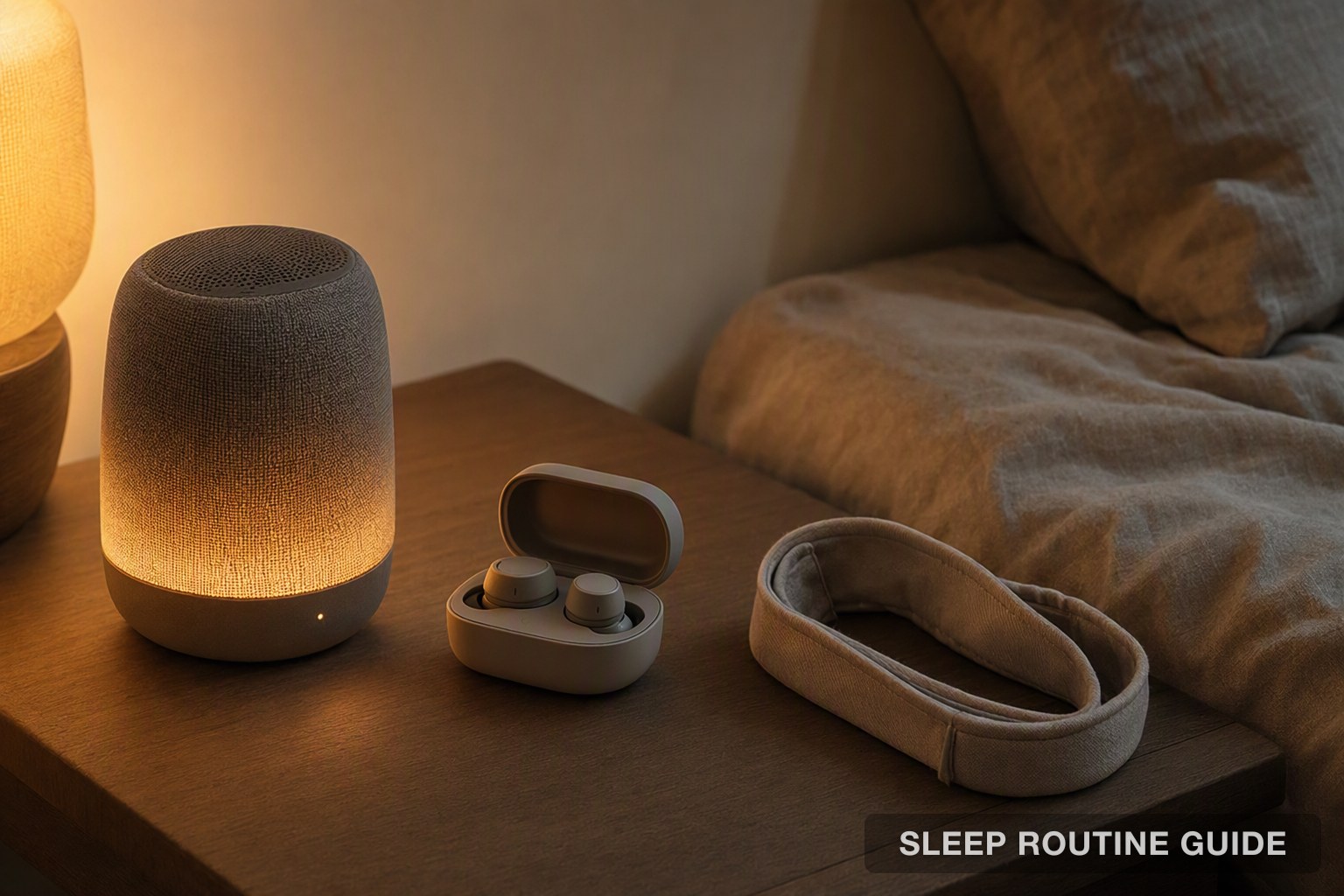
Sound Therapy Startups: Who Is Building What for Sleep and Relaxation
Sound therapy startups for sleep and relaxation split into five groups: audio apps (Endel, Brain.fm), brainwave-timed headbands (Elemind at $399, FRENZ Brainband at $680), tinnitus devices (Lenire by Neuromod), in-ear and on-body hardware (Ozlo Sleepbuds 2 at $279, Sensate at $299) and bedside sound devices (Hatch Restore 3 at $169.99, Naptick at $349). Only Lenire holds an FDA authorization, a De Novo grant dated 6 March 2023 for tinnitus; the rest are general wellness products. Elemind and FRENZ have company-run peer-reviewed sleep studies, while Hatch, Ozlo, Sensate and Naptick link to no peer-reviewed trial of their own product. Independent reviews rate the evidence for white and pink noise as weak, and a 2026 lab study found pink noise reduced REM sleep in 25 adults.
Sound therapy startups for sleep and relaxation fall into five groups: generative audio apps (Endel, Brain.fm), brainwave-timed headbands (Elemind at $399, FRENZ Brainband at $680), prescription tinnitus devices (Lenire by Neuromod, the only one here with an FDA De Novo grant), in-ear and on-body hardware (Ozlo Sleepbuds 2 at $279, Sensate at $299), and bedside sound devices (Hatch Restore 3 at $169.99, Naptick at $349). Only Lenire is a regulated medical device. Every other company on this map sells a general wellness product, and the independent reviews of white and pink noise for sleep rate the evidence as weak.
That gap between how much sound-for-sleep hardware is on sale and how little the systematic reviews support it is the main thing to understand before buying anything here. This guide maps who is building what, which study each company points to, and where the science stops.
Key takeaways
- One company on this map holds an FDA authorization: Neuromod's Lenire, granted De Novo status on 6 March 2023 for tinnitus. It is prescribed through clinics and has no published retail price.
- Elemind and FRENZ are the only sleep products here with a peer-reviewed study of the actual device. Both studies were run or sponsored by the companies.
- Endel and Brain.fm each cite a peer-reviewed paper, but both papers measure focus and attention, not sleep.
- Hatch, Ozlo, Sensate and Naptick do not link to a peer-reviewed trial of their own product. Sensate cites its own pilot study.
- A 2021 systematic review of 38 studies rated the evidence that continuous noise improves sleep as very low quality, and a 2026 lab study found pink noise at 40 or 50 dBA reduced REM sleep in 25 healthy adults.
- Naptick fits in the bedside group as a preorder device with a 1,000+ track sound library. It has no published study and its app is iOS only for now.
The sound therapy startup map at a glance
"Sound therapy" has no regulatory definition. In this article it means a product whose main intervention is audio or vibration delivered to help someone fall asleep, stay asleep, relax, or cope with tinnitus. Trackers that only measure sleep are out of scope.
| Company | Approach | Price on its own site | Regulatory status | Evidence it cites |
|---|---|---|---|---|
| Endel | Generative soundscapes (app) | App Store lists plans up to $19.99 a month or $119.99 a year | Wellness app | Peer-reviewed focus study, co-funded by Endel |
| Brain.fm | Functional music (app) | $14.99 a month or $99.99 a year | Wellness app | Peer-reviewed attention study, employee co-authors |
| Elemind | EEG headband, sound pulses timed to alpha waves | $399, optional premium from $6.99 a month | General wellness, per its FAQ | Company-sponsored crossover trial, 21 people |
| FRENZ Brainband (Earable) | EEG headband, bone-conduction audio | $680 | Wellness device, per its site | Scientific Reports paper, 2023 |
| Lenire (Neuromod) | Sound plus tongue stimulation for tinnitus | Not published, clinic prescribed | FDA De Novo, DEN210033 | Pivotal trial, 112 participants |
| Ozlo | Sleep earbuds, noise masking | $279 | Consumer product, no FDA clearance found | None linked for the product |
| Sensate | Chest-worn vibration with synced audio | $299 | Consumer wellness product | Company pilot study |
| Hatch | Bedside sound machine and sunrise clock | $169.99, Hatch+ at $5.99 a month | Consumer product | None linked for the product |
| Naptick | Bedside speaker, light, room sensors, AI coach | $349 preorder, no subscription | Wellness device, per its site | None published |
Prices were read from each company's own product or pricing page on 13 October 2026. Promotions change them often.
How we evaluated
We fetched each company's own website and recorded the price, the product description and any regulatory statement as they appeared on 13 October 2026. For evidence, we looked for a peer-reviewed paper that tested the company's product, then read the abstract and the competing-interest statement. For regulatory status we used the FDA's public De Novo database and each company's own wording. Funding figures come from named press coverage and are only included where we could open the article.
We did not test any device. Nothing here is a hands-on review, and the grouping below is by approach, not by which product works best. On the evidence available, nobody can honestly rank these nine against each other for sleep.
What the research supports, and what it does not
Start with the independent literature, because it sets a ceiling on what any company in this category can claim.
White and pink noise
Riedy and colleagues at the University of Pennsylvania reviewed 38 studies of continuous white or broadband noise and sleep. Results ran in both directions, with some studies showing better sleep and others worse. Using the GRADE criteria, the authors rated the quality of evidence as very low and wrote that this "contradicts its widespread use."
A second review, published in the Journal of Clinical Sleep Medicine in 2022, covered 34 studies and 1,103 participants. Six of 18 white noise studies (33%) and nine of 11 pink noise studies reported a positive sleep outcome. That sounds encouraging for pink noise until you read the conclusion: "there was no strong evidence to support use of auditory stimulation." The pink noise studies also had a higher risk of bias than the mixed-audio ones. The same review found no adverse effects reported with short-term use.
Then came a result that cut the other way. In a seven-night polysomnography study from the same Penn group, published in the journal Sleep in 2026, 25 healthy adults slept under aircraft noise, pink noise, earplugs and combinations. Pink noise at 40 or 50 dBA reduced REM sleep compared with a quiet night, and adding pink noise on top of environmental noise made sleep structure worse. Earplugs handled the traffic noise better. It is one lab study of young, healthy sleepers, so it does not prove that a sound machine at home is harmful. It does mean "pink noise for deeper sleep" is not a settled claim.
Timed sound pulses during deep sleep
Closed-loop acoustic stimulation is a different technique. Short sound pulses are timed to the rising phase of slow brain waves, with the aim of strengthening deep sleep. A 2021 meta-analysis of 10 studies and 177 participants found a small effect on overnight memory (Hedges' g of 0.25, p = 0.07) and concluded that "the evidence is not sufficient to recommend the use of commercially available devices." We found a second meta-analysis on the same question, but it has since been retracted, so we have not used it.
Music
Music has the strongest support of anything in this article. A 2022 Cochrane review of 13 trials and 1,007 participants found moderate-certainty evidence that listening to music improves self-rated sleep quality in adults with insomnia symptoms. The three trials that used objective sleep measures did not show a clear improvement. In other words, people feel they slept better, and instruments mostly do not see it.
Sound for tinnitus
A 2018 Cochrane review of sound therapy for tinnitus (eight studies, 590 participants) found no evidence that hearing aids or sound generators beat a waiting list, placebo or education alone. That is the backdrop against which Lenire's bimodal approach was developed.
Generative and functional audio apps
These are the cheapest way into the category and the easiest to quit. Neither company makes hardware.
Endel
Endel, based in Berlin, generates soundscapes in real time for focus, relaxation and sleep. It raised a $15 million Series B in April 2022 led by Waverley Capital and True Ventures, which TechCrunch put at $22.1 million in total funding. The company's site says its sleep sounds were made with SleepScore Labs.
The study Endel calls its validation is a 2022 paper in Frontiers in Computational Neuroscience that compared its Focus soundscape with Spotify and Apple Music playlists and with silence. It measured focus using a brain-computer interface, not sleep. The authors worked for Arctop, and the paper states that Arctop and Endel funded it. We did not find a peer-reviewed sleep trial of Endel.
Pricing is hard to pin down. Endel's website does not show a public price list, and its US App Store listing shows in-app purchases that range from $2.99 to $19.99 for a month and $34.99 to $119.99 for 12 months, plus a $124.99 lifetime option. Expect the price you are offered to depend on the promotion.
Brain.fm
Brain.fm sells what it calls functional music, with amplitude modulation added to the audio. Its pricing page lists $14.99 a month or $99.99 a year, and the app has sleep modes including Deep Sleep, Wind Down and Power Nap.
Its headline paper is in Communications Biology (2024). It reports that music with rapid modulation supported attention, most of all in listeners with attentional difficulties. The lead author is a Brain.fm employee with equity options, which the paper discloses, and the article carries two published author corrections. Like Endel's study, it is about attention. We found no peer-reviewed trial of Brain.fm's sleep tracks, and we could not confirm a venture funding figure for the company from a source we trust.
Brainwave-timed headbands
This is the group with the most interesting science and the highest attrition. Dreem, the Paris-based sleep headband company, is no longer an independent consumer brand: Beacon Biosignals acquired Dreem's research and development business in July 2023 to run at-home sleep monitoring for clinical trials. Two startups are still selling.
Elemind
Elemind, founded by researchers from MIT, makes an EEG headband that plays sound pulses timed against the wearer's alpha waves in the minutes before sleep. That is a different target from the deep-sleep stimulation covered in the meta-analysis above. Its site lists "Deep Sleep Stimulation" as coming soon.
The supporting trial was published in Scientific Reports in 2024. It was a randomized crossover study of adults who took more than 30 minutes to fall asleep. Among the 21 people analysed, average time to fall asleep dropped by 10.5 minutes, with a standard deviation of 15.9 minutes. That wide spread means some participants improved a lot and others not at all. Four of the authors are Elemind employees and the company sponsored the study.
The headband costs $399. The core features stay free, and a premium app tier costs $6.99 a month billed annually or $12.99 month to month after a 30-day trial. Elemind's FAQ states that it "is not a medical device" and is "a general wellness product." Sleep Review reported that the company came out of stealth with a $12 million seed round in early 2024.
FRENZ Brainband by Earable
Earable's FRENZ Brainband tracks EEG and other signals, then plays audio through bone conduction. Its site lists it at $680, with a rental option, US shipping only and iOS support only. The footer says it "is a wellness device and not a medical device."
Earable's evidence is a 2023 Scientific Reports paper that reports 883 sleep studies on 377 subjects, 87.8% agreement with technician sleep scoring, and a 24.1 minute reduction in time to fall asleep with stimulation. Those are bigger numbers than Elemind's. The paper describes the authors' own system, so treat it as a company study until someone independent repeats it. We could not confirm Earable's funding from a primary source.
Tinnitus sound therapy
Tinnitus is the one corner of this market where a startup has gone through the FDA.
Lenire by Neuromod
Neuromod Devices, based in Dublin, makes Lenire. It pairs sound played through headphones with mild electrical stimulation of the tongue. The FDA's database lists it under De Novo number DEN210033, classified as a "combined acoustic and electrical external stimulation device for the relief of tinnitus," with the decision granted on 6 March 2023.
The pivotal trial, TENT-A3, was published in Nature Communications in 2024. All 112 participants did six weeks of sound alone, then six weeks of sound plus tongue stimulation. Among people with moderate or worse tinnitus, 58.6% responded to the combined treatment against 43.2% for sound alone. The abstract is candid that this advantage was "not observed in the full cohort across all severity groups." It was a single-arm design with participants as their own controls, not a blinded sham comparison, and one author consults for Neuromod.
Lenire is prescribed and fitted by an audiologist or ENT. Neuromod does not publish a US price, so ask the clinic. The company closed a €30 million financing in 2023, and in June 2024 its US arm won a Federal Supply Schedule contract that makes Lenire available through the Department of Veterans Affairs.
Lenire is a tinnitus treatment. It is not a sleep product, and nothing in its authorization covers insomnia.
In-ear and on-body hardware
Ozlo Sleepbuds
Ozlo was started by former Bose employees who bought the Sleepbuds IP after Bose dropped the product. The current Sleepbuds 2 are listed at $279, with sleep sounds stored on the buds and the option to stream your own audio. The claim is simple and modest: mask a snoring partner or street noise with something more comfortable than regular earbuds.
TechCrunch reported in October 2024 that Ozlo had raised a $12 million round led by LifeArc Ventures, on top of an earlier $10.1 million and roughly $8 million from crowdfunding, and that part of the money was earmarked for FDA clearance of a tinnitus therapy. We could not confirm that any clearance has been granted, and the product pages we read today make no tinnitus treatment claim. Ozlo does not link to a trial of the Sleepbuds. Given the 2026 Penn finding that earplugs outperformed pink noise against traffic noise, the passive noise blocking may matter as much as the sounds.
Sensate
Sensate is a pebble-shaped device that sits on the chest and vibrates in sync with soundscapes played through headphones. The company calls this "vagus nerve toning." The single device is $299, and a Sensate Plus subscription unlocks a larger sound library.
This is the vibroacoustic end of the market, and the evidence is the thinnest of the hardware group. Sensate's site cites its own pilot study (55 extra minutes of sleep a night) and a lab study of brain activity. We did not find either in a peer-reviewed journal linked from its science page, and "toning" the vagus nerve through the breastbone is the company's description, not an established clinical mechanism. Sound-bath beds and vibroacoustic loungers sold to spas sit in the same position. We left those companies out because we could not verify enough about any of them.
Bedside sound devices
Bedside devices are where most people actually meet sound for sleep. Nothing goes on your head or in your ears, which removes the comfort problem, but also means the device cannot time anything to your brain activity.
Hatch Restore 3
Hatch's Restore 3 is a sound machine, sunrise alarm and reading light for $169.99, with a 30-night trial. It works without a subscription, but with limits. Hatch's membership page shows the free tier includes five meditations and five sleep music tracks, with full access at $5.99 a month for Hatch+. Over three years that subscription adds about $216 to the price.
Hatch does not link to a clinical study of the Restore on its product page, and it does not need to for what it claims. It is a nicely made bedside speaker and light. The app is a recurring complaint in the company's own review summary, which notes that "some find the app confusing."
Naptick
Naptick is a newer bedside device that combines four things: a full-range speaker with a library of 1,000+ soundscapes, meditations and sleep tracks including white, pink and brown noise, a warm light for winding down and waking, eight room sensors (CO₂, VOC, particulates, temperature, humidity, light and noise) that feed a 0 to 100 room score, and a conversational AI coach called Nap. The product page lists it at $349 with the app included and states that there is no subscription. If AI coaching is the part that interests you, our explainer on what a sleep coach is covers that side.
Sound is a real part of the product, so it belongs in this group. But Naptick's sound feature is masking and relaxation audio played into the room, the same basic idea as a Hatch. Its science page says as much: "a steady soundscape raises the noise floor evenly." It does not time sound to brain activity and does not claim to. The same page states that Naptick "is a wellness device" and "is not a medical device and is not intended to diagnose or treat any condition."
What to consider before preordering:
- It is a preorder product. The site says batches 1 and 2 sold out and that batch 3 "ships August 2026." That date has passed and the page still says preorder, so ask the company for a current delivery estimate.
- No study of Naptick itself has been published. The site links to a Substack and a white paper, not a peer-reviewed trial.
- The app is iOS only. Google Play is marked "coming soon."
- At $349 it costs about twice a Hatch Restore 3 up front. The comparison flips if you would pay for Hatch+: three years of that subscription brings the Hatch to roughly $386.
- The 60-night money-back guarantee on the product page sits alongside a refund policy that says a returned item "must be unused" and that the customer pays return shipping. Get clarity in writing on which applies.
- The library includes pink noise. See the 2026 REM finding above before running it all night at volume.
Company evidence compared
The table below separates what each company can point to from what an independent reader should make of it.
| Company | Study of the actual product? | What it measured | Who ran it | Our read |
|---|---|---|---|---|
| Lenire | Yes, pivotal trial | Tinnitus severity | Multi-site, one author consults for Neuromod | Strongest here, benefit limited to moderate or worse tinnitus |
| Elemind | Yes, crossover RCT | Time to fall asleep | Elemind employees, company sponsored | Promising, 21 people, needs replication |
| FRENZ | Yes | Sleep scoring accuracy, time to fall asleep | Authors' own system | Large sample, not independent |
| Brain.fm | Yes | Attention | Employee lead author | Says nothing about sleep |
| Endel | Yes | Focus | Arctop, co-funded by Endel | Says nothing about sleep |
| Sensate | Company pilot only | Self-reported sleep and stress | Sensate | Not peer reviewed that we could find |
| Hatch | None linked | Not applicable | Not applicable | Makes modest claims |
| Ozlo | None linked | Not applicable | Not applicable | Makes modest claims |
| Naptick | None published | Not applicable | Not applicable | Unproven, preorder stage |
How regulation divides this market
The FDA's general wellness guidance, reissued in January 2026, covers low-risk products intended for maintaining or encouraging a healthy lifestyle and unrelated to the diagnosis, cure, mitigation, prevention or treatment of a disease or condition. That is why eight of these nine companies talk about "better sleep" and "relaxation" and none of them says "treats insomnia." The moment a company claims to treat a condition, it needs to go the way Neuromod did.
For a buyer this has a practical meaning. A wellness label is not a quality mark and not a warning. It tells you that no regulator has reviewed the product's effectiveness. If you have long-term insomnia, the US National Heart, Lung, and Blood Institute says cognitive behavioral therapy for insomnia is usually recommended as the first treatment option, and none of these products replaces it. If you have persistent tinnitus, see an audiologist before buying consumer hardware.
Investors read the same divide differently, since a regulated claim is slow and expensive but harder to copy. That angle, along with the larger sleep-tech names, is covered in our piece on companies to invest in for smart sleep.
Limitations
We did not use or test any of these products. Prices and features were read from company websites on one day and will drift. Funding figures for Endel, Elemind, Ozlo and Neuromod come from press coverage dated 2022 to 2024, so later rounds may exist. We could not confirm funding for Brain.fm, Earable, Sensate, Hatch or Naptick from a source we could open, and left it out.
We could not verify whether Ozlo has since obtained FDA clearance for a tinnitus feature, whether Naptick's third batch has shipped, or what Lenire costs at US clinics. We relied on study abstracts and competing-interest statements, not full statistical appraisal of each paper. Several headband and sleep-earbud makers beyond Dreem are widely reported to have left the consumer market. We only named the one whose status we could confirm. This map is also not exhaustive: there are many more sound apps and white noise machines than the nine companies covered.
Frequently asked questions
What is a sound therapy startup?
It is a young company whose product uses audio or vibration as the main intervention for sleep, relaxation or tinnitus. The term covers apps like Endel and Brain.fm, headbands like Elemind and FRENZ, the prescription tinnitus device Lenire, and consumer hardware from Ozlo, Sensate, Hatch and Naptick. There is no regulatory definition of "sound therapy," so the label alone tells you nothing about evidence.
Which sound therapy startups are FDA cleared?
Of the nine companies covered here, only Neuromod has an FDA authorization. Lenire received a De Novo grant (DEN210033) on 6 March 2023 for the relief of tinnitus. Elemind, FRENZ and Naptick each state on their own sites that they are wellness products and not medical devices. The others make consumer claims that do not require clearance.
Does pink noise improve sleep?
The evidence is mixed and recently got less favorable. A 2022 systematic review counted nine positive results among 11 pink noise studies but concluded there was no strong evidence to support auditory stimulation. A 2026 polysomnography study of 25 adults then found that continuous pink noise at 40 or 50 dBA reduced REM sleep. If pink noise helps you fall asleep, a sleep timer is a reasonable precaution.
Is white noise bad for you?
Nobody has shown that. The 2021 systematic review of 38 studies found results in both directions and rated the evidence for a benefit as very low quality. Its authors also noted that continuous noise might negatively affect sleep and hearing, and called for more research before promoting it as a sleep aid. Keeping the volume low is sensible.
Do sleep headbands that play sounds work?
Two have published results, and both were company studies. Elemind's trial of 21 adults found people fell asleep 10.5 minutes faster on average, with wide variation between individuals. Earable reported a 24.1 minute reduction with its FRENZ Brainband. For deep-sleep stimulation more broadly, a 2021 meta-analysis judged the evidence insufficient to recommend commercial devices.
How much do sound therapy devices cost?
On the companies' own sites on 13 October 2026: Hatch Restore 3 was $169.99, Ozlo Sleepbuds 2 $279, Sensate $299, Naptick $349, Elemind $399 and FRENZ Brainband $680. Brain.fm costs $99.99 a year. Hatch and Elemind have optional subscriptions on top, Naptick states it has none, and Lenire is priced by the prescribing clinic.
Is Naptick a sound therapy device?
Partly. Naptick is a bedside device whose speaker plays a 1,000+ track library of soundscapes, meditations and colored noise, so sound is one of its main functions alongside light, room sensing and an AI coach. It is a wellness device by its own description, has no published study, and is sold on preorder at $349.
The short version
Sound therapy for sleep is a market where product design is well ahead of the proof. Music has moderate evidence for how people rate their own sleep. Broadband noise has very low-quality evidence and one recent warning about REM. Brainwave-timed sound is the most promising idea, and it rests on two company-run studies.
If you want to try sound without much risk, start with an app or a basic bedside speaker, keep the volume down and use a timer. If the problem is tinnitus, the path runs through an audiologist. For the newer hardware, including Elemind, FRENZ and Naptick, you are an early adopter, and the return policy is the most important line on the product page.
This article is for general informational purposes only and is not medical advice. Unless stated otherwise, the products described are general wellness products that are not intended to diagnose, treat, cure, or prevent any condition. Prices, features, and regulatory status change; verify them with each company, and talk to a physician or audiologist about persistent insomnia or tinnitus before relying on any device or app.
Reviewed for accuracy by the Sleep Routine Guide editorial team. Company, funding and product details were cross-referenced against the cited sources as of the review date. Last reviewed: October 13, 2026.
Last verified: 2026-10-13
Sources
- U.S. Food and Drug Administration | De Novo DEN210033, Lenire Tinnitus Treatment Device
- Journal of Clinical Sleep Medicine (PMC) | Systematic review: auditory stimulation and sleep
- Sleep (PMC) | Efficacy of pink noise and earplugs for mitigating the effects of intermittent environmental noise exposure on sleep
- Cochrane Database of Systematic Reviews (PMC) | Listening to music for insomnia in adults
- Cochrane Database of Systematic Reviews (PMC) | Sound therapy (using amplification devices and/or sound generators) for tinnitus
- Nature Communications | Combining sound with tongue stimulation for the treatment of tinnitus: a multi-site single-arm controlled pivotal trial
- Scientific Reports | A randomized controlled trial of alpha phase-locked auditory stimulation to treat symptoms of sleep onset insomnia
- Scientific Reports | A comprehensive study on the efficacy of a wearable sleep aid device featuring closed-loop real-time acoustic stimulation
- Communications Biology | Rapid modulation in music supports attention in listeners with attentional difficulties
- Frontiers in Computational Neuroscience | Measuring and modeling the effect of audio on human focus in everyday environments
- National Heart, Lung, and Blood Institute | Insomnia treatment
- TechCrunch | As Ozlo's Sleepbuds go on sale, company raises funds for tinnitus treatment
- Sleep Review | Beacon Biosignals Bolsters Sleep Medicine Research Through Acquisition of Dreem
- Naptick | The Naptick Device